
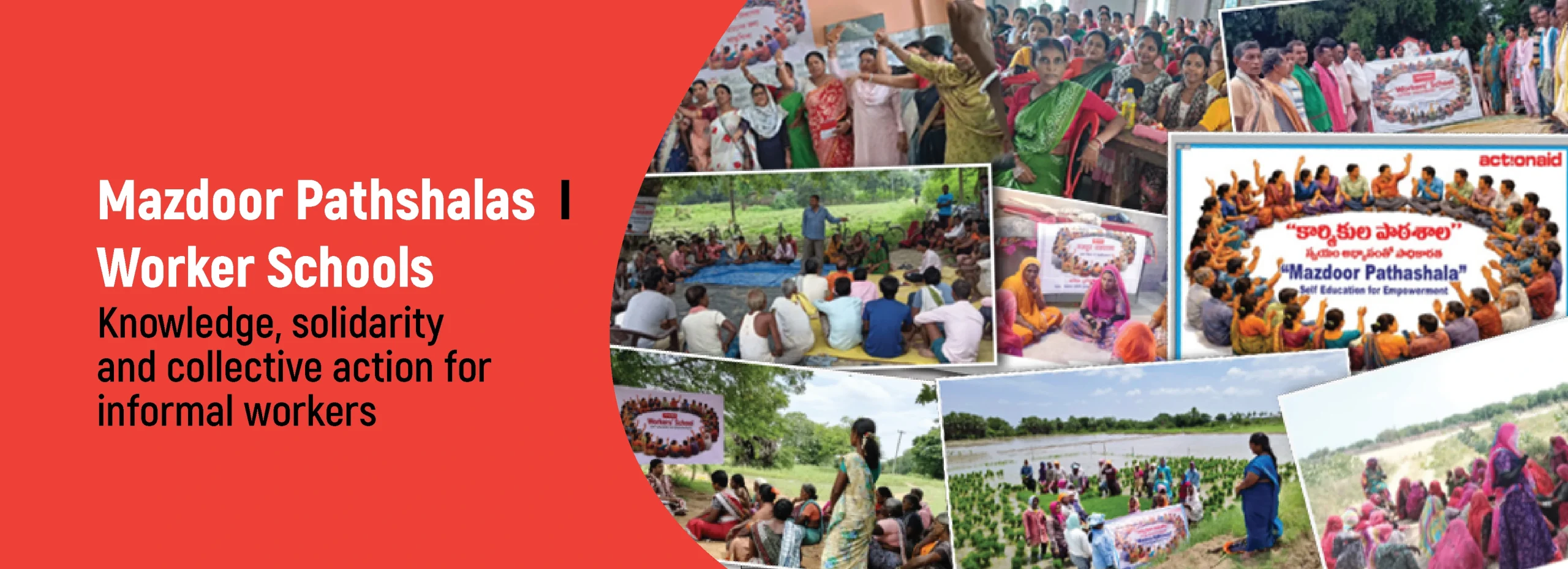
Mazdoor Pathshalas | Worker Schools
Knowledge, solidarity and collective action for informal workers
Mazdoor Pathshalas are community-based learning spaces that help informal workers understand their rights, access social-security benefits and act collectively to improve their working and living conditions.
More than 90% of India’s women workers are part of the informal economy, working on farms, in private homes and construction sites, or as street vendors and hawkers. Many informal workers remain unaware of the laws, protections and welfare programmes available to them.
ActionAid Association launched Mazdoor Pathshalas following the implementation of India’s four Labour Codes in November 2025. The initiative helps workers understand the new provisions, existing state labour laws and the welfare boards established for different categories of workers.
Learning Spaces Designed Around Workers
Mazdoor Pathshalas are organised within communities and at workplaces, at times convenient for workers. They bring together agricultural and construction workers, sugarcane cutters, fish workers, street vendors, hawkers, and gig and platform workers.
These participatory spaces enable workers to:
- Learn about labour rights and protective legal provisions
- Understand social-security and welfare schemes
- Share workplace experiences and challenges
- Receive practical guidance and advice
- Engage collectively with government authorities
- Seek redress and overcome barriers to their entitlements
Our Reach
The initiative has reached workers across 200 districts.
- More than 200,000 people reached
- Over 50% of participants were women workers
Stories of Change in Action
Collective action restores livelihoods in Kashmir
In Yusmarg, Kashmir, pony ride vendors were struggling to support their families following the prolonged closure of tourism sites. The issue was discussed during Mazdoor Pathshala sessions, where workers decided to approach the local authorities collectively.
For three months, groups of pony vendors took turns meeting the local administration. Their sustained advocacy contributed to the partial reopening of tourist destinations, bringing relief to families dependent on tourism-based livelihoods.
Connecting workers’ rights with climate justice
ActionAid Association’s Jaipur team undertook action research on climate justice with informal workers in the city. The resulting handbook supports community leaders in strengthening workers’ legal awareness and access to entitlements.
Its findings have also informed locally developed action plans for conducting Mazdoor Pathshalas across Rajasthan.
Resources for Community Leaders
To expand access to useful information, ActionAid Association has developed training manuals and handbooks for field teams and community leaders. These practical resources cover wages, workplace safety, health, maternity rights, social security, contractors, loan-related matters and other concerns affecting informal workers.

Objectives of the Campaign
1. Making Workers Aware of Their Rights
Mazdoor Pathshalas help informal workers understand labour laws, welfare boards and protective provisions. Workers gain practical knowledge to recognise violations and claim their rights and entitlements.
2. Taking Learning to Workers
Sessions are organised within communities and at workplaces, at times convenient for workers. They engage agricultural and construction workers, sugarcane cutters, fish workers, street vendors, hawkers, and gig and platform workers.
3. Expanding Access to Social Security
Workers learn about fair wages, timely payments, workplace safety, maternity rights, health insurance, employment guarantees and welfare schemes. The initiative also facilitates dialogue with government authorities to address barriers.
4. Creating Impact at Scale
Mazdoor Pathshalas have been organised across 200 districts, reaching more than 200,000 people. Over 50% of the workers participating in the initiative have been women.
5. Turning Knowledge into Collective Action
The Pathshalas enable workers to share experiences, seek legal guidance and collectively raise concerns with authorities. These efforts have helped address rights violations, improve access to schemes and protect livelihoods.