
Urban Action School 2026 REIMAGINING CITYZENS with LOCAL GOVERNANCE
 Author:
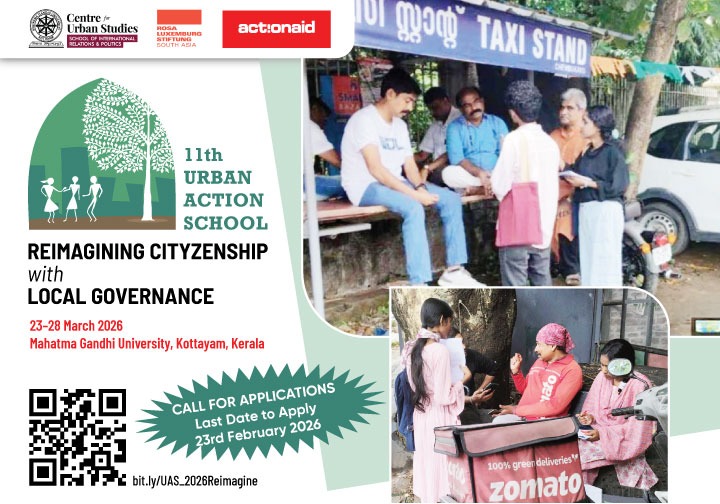
Indian cities are living through a paradox. They are engines of economic growth, cultural churn, and political aspiration, yet they remain administratively fragmented, fiscally constrained, and democratically thinned out. Over the years, urban governance has been reduced to a narrow conversation around municipal functions, projects, and schemes, while deeper questions of power, participation, care for the commons, and collective decision-making have steadily slipped out of view.
The 11th Urban Action School emerges from this growing unease, especially as it becomes increasingly clear that urbanisation in India has grown much faster than projected—particularly when measured through data on mobility, labour markets, density, and built-up areas.
The Urban Action School (UAS) is not a training programme in the conventional sense, nor a toolkit of “best practices”. It is a space to think, argue, unlearn, and re-imagine what governing cities could mean in the decades ahead—at a time when climate stress, informality, digital mediation, and social fragmentation are reshaping urban life.
This note is meant to serve as a guide for prospective participants: what the Urban Action School 2026 (UAS’26) is about, what it is not, and how it draws its intellectual and political energy from the idea of collective local governance.
Local Self-Government to Collective Governance
For long, the urban governance debate in India has been trapped within the institutional grammar of local self-governments—municipal corporations, councils, mayors, and commissioners. While these institutions matter deeply, the crisis of cities cannot be addressed by administrative reform alone and calls for “CityZen”-centred thinking.
Collective local governance asks a more fundamental question: Who governs the city in practice?
Cities are already governed—informally and unevenly—by residents’ associations, street vendors’ collectives, women’s savings groups, sanitation workers, transport unions, digital platforms, planners, courts, and capital. What is missing is a framework that recognises these actors not as beneficiaries or obstacles, but as co-governors of urban life and the urban future.
UAS’26 is anchored in this shift—from government to governance, and from governance to collective stewardship. It treats the city as a shared political project, not merely a service-delivery machine.
What the Urban Action School 2026 Seeks to Do
Active for more than a decade now, the UAS has evolved as a reflective and practice-oriented space. It brings together elected representatives, urban practitioners, planners, activists, researchers, and young professionals who are dissatisfied with siloed thinking and narrow imaginaries that are woefully unfit for the future.
UAS’26 seeks to:
- Re-frame urban governance beyond schemes, projects, and infrastructure, and locate it within questions of democracy, justice, and the commons.
- Interrogate the limits of existing municipal systems while remaining grounded in the realities of Indian cities.
- Explore how people’s governance—through collectives, unions, neighbourhood institutions, and informal arrangements—already sustains cities, often invisibly.
- Examine the extent to which the 74th Constitutional Amendment has succeeded in reimagining local self-rule, and what more is required to strengthen it.
- Build a shared language around co-production, deliberation, care, accountability, and long-term urban stewardship.
This is not about offering ready-made answers. It is about cultivating the capacity to ask better questions—and to sit with uncertainty while imagining alternatives and developing pathways to realise them.
Pedagogy: learning from the city, not about it
The UAS does not follow a classroom model. The city itself is treated as the primary text.
Participants are encouraged to draw from their own lived and professional experiences—whether of governance failure, institutional friction, grassroots innovation, or political negotiation. Case narratives, field-based reflections, and collective discussions form the core of the learning process.
Equally important is the emphasis on unlearning: questioning inherited planning doctrines, technocratic solutions, and false binaries between state and society, formal and informal, expert and citizen.
The UAS values considered thinking in a time of policy haste. It creates room for disagreement, reflection, and intellectual discomfort—recognising that transformative ideas rarely emerge from consensus alone.
Urban futures and the question of power
A central concern of UAS’26 is power: who decides, who benefits, and who bears the cost of urban transformation.
Future urban governance cannot be imagined without confronting:
- The growing distance between decision-making and everyday urban life.
- The marginalisation of informal workers and settlements despite their centrality to city economies.
- The enclosure and privatisation of urban commons—land, water, mobility, and digital infrastructure.
- The hollowing out of political imagination at the city level.
Drawing from the collective local governance pillar, UAS’26 invites participants to think of governance as an ethical and political practice—one that is negotiated, contested, and continuously produced.
Who Should Participate
UAS’26 is meant for those willing to think beyond their professional labels. It speaks to:
- Elected representatives seeking to reclaim the political space of cities.
- Practitioners and planners frustrated with project-centric urbanism.
- Activists and organisers working with communities and informal workers.
- Researchers and students interested in grounded, action-oriented urban theory.
What binds participants together is not expertise, but a shared discomfort with the status quo and a curiosity about alternative futures.
An Invitation
At its core, UAS’26 is an invitation—to pause, listen to the city anew, and imagine forms of governance that are democratic, collective, and future-ready.
At a moment when urban policy is increasingly driven by speed, scale, and spectacle, the School insists on something quieter but more enduring: the slow rebuilding of trust, institutions, and political imagination from below.
This is not a retreat from action. It is a preparation for more meaningful action.
Participants leave not with a manual, but with sharper questions, deeper solidarities, and a renewed sense that cities can still be governed as shared spaces of life, care, and possibility.
Call for Applications
The programme includes lectures, workshops, group work, and community immersion. Participants form outside Kottayam will be provided accommodation and meals. Travel support will be provided on the basis of need.
Venue: Mahatma Gandhi University, Kottayam, Kerala
Dates: 23–28 March 2026
Deadline to apply: 23 February 2026
Join us to learn, reflect, and work together towards cities that are inclusive, democratic, and centred on people.
Apply now: https://forms.gle/U5stjUUG3Qo8WRx96